GPU and CPU performance¶
How probjax's kernels and models compare with the alternatives in JAX and PyTorch, in time and memory, on a consumer NVIDIA GPU and on CPU:
- Attention:
dot_product_attention,flex_attentionandmhaagainstjax.nn(XLA, cuDNN) and PyTorch SDPA; memory, short sequences, GQA and split-KV decoding, CPU. - Sequence mixers, kernel sums and MoE: SSD, Mamba scan, residual linear attention, Gated DeltaNet,
rbf_kernel_mv/ KDE,kernel_logsumexp/ Sinkhorn / OT, MoE grouped matmul. - Models:
Transformer/DiffusionTransformerperattention_fn,scan_layersandremat_policy,SSMModelcells,UNet,MoELayer. - H100 (Hopper): the same suites on an H100, H100 vs RTX 3090, the device-specific attention defaults for sm_90 (cuDNN routing, the Mosaic GPU backend, backward choice), MoE dispatch on H100, and PyTorch (
flex_attention, SDPA) on H100.
Devices. These pages measure the RTX 3090 unless they say otherwise; the H100 results are on their own page. Defaults can differ per device: on sm_90 flex_attention / dot_product_attention route large bf16 calls to cuDNN and resolve backward_pass_impl="auto" differently (rules).
At a glance¶
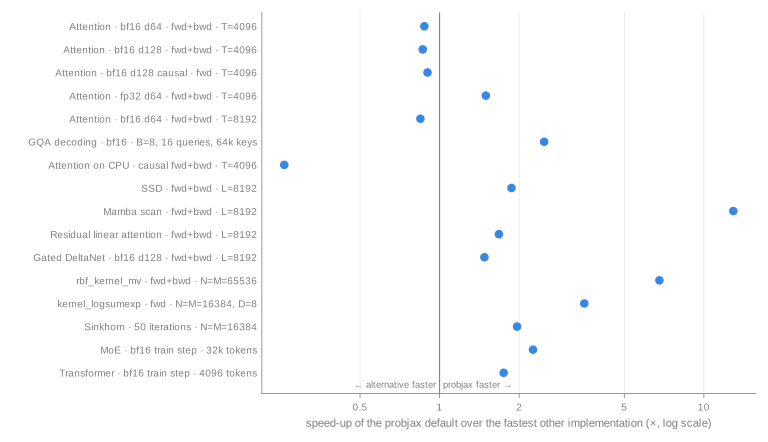
Time of the fastest other implementation that ran (another probjax implementation or an external library) divided by the time of the probjax default, RTX 3090; the CPU row ran on the shared host. Right of the line: the default is faster.
| workload | probjax default | ms | fastest other implementation | ms | speed-up |
|---|---|---|---|---|---|
| Attention · bf16 d64 · fwd+bwd · T=4096 | probjax dot_product_attention (default) |
8.87 | torch SDPA flash | 7.77 | 0.88× |
| Attention · bf16 d128 · fwd+bwd · T=4096 | probjax dot_product_attention (default) |
17.4 | torch SDPA flash | 15.1 | 0.86× |
| Attention · bf16 d128 causal · fwd · T=4096 | probjax dot_product_attention (default) |
2.47 | torch SDPA flash | 2.22 | 0.90× |
| Attention · fp32 d64 · fwd+bwd · T=4096 | probjax dot_product_attention (default) |
19.5 | jax.nn XLA |
29.2 | 1.50× |
| Attention · bf16 d64 · fwd+bwd · T=8192 | probjax dot_product_attention (default) |
33.8 | torch SDPA flash | 28.6 | 0.85× |
| GQA decoding · bf16 · B=8, 16 queries, 64k keys | probjax split-KV (default) | 4.02 | jax.nn cuDNN |
9.99 | 2.49× |
| Attention on CPU · causal fwd+bwd · T=4096 | probjax mha (auto strategy) |
392 | torch SDPA | 101 | 0.26× |
| SSD · fwd+bwd · L=8192 | ssd chunked (default) |
11.9 | ssd Pallas (implementation='pallas') |
22.2 | 1.87× |
| Mamba scan · fwd+bwd · L=8192 | Triton scan (GPU default) | 5.07 | chunked XLA scan (CPU default) | 65.6 | 13× |
| Residual linear attention · fwd+bwd · L=8192 | chunked (default) | 3.79 | Pallas fwd + chunked bwd | 6.36 | 1.68× |
| Gated DeltaNet · bf16 d128 · fwd+bwd · L=8192 | Pallas (GPU default) | 20.5 | chunked, more residuals | 30.4 | 1.48× |
| rbf_kernel_mv · fwd+bwd · N=M=65536 | Pallas (GPU default) | 58.7 | row-blocked XLA (CPU default) | 399 | 6.79× |
| kernel_logsumexp · fwd · N=M=16384, D=8 | kernel_logsumexp (Pallas) |
1.24 | dense logsumexp | 4.38 | 3.53× |
| Sinkhorn · 50 iterations · N=M=16384 | kernel_logsumexp (Pallas) |
127 | dense logsumexp | 250 | 1.96× |
| MoE · bf16 train step · 32k tokens | Pallas, sorted (GPU default) | 16.0 | blocked | 36.1 | 2.26× |
| Transformer · bf16 train step · 4096 tokens | default dot_product_attention |
50.1 | jax.nn cuDNN |
87.5 | 1.75× |
Exact shapes are on the linked pages; ratios at other shapes differ, sometimes a lot.
Setup¶
| GPU | NVIDIA GeForce RTX 3090, 24 GB (sm_86, about 99 KB opt-in shared memory per block) |
| Driver | 615.78.08 |
| JAX | 0.11.2 (Pallas on Triton for GPU kernels) |
| PyTorch (comparisons only) | 2.14.1+cu130 (CUDA 13.0) |
| Python | 3.14.8 |
| Host | 24 CPU threads, shared with other jobs |
Every JSON file records the device, the library versions and the runner configuration under device and config.
Methodology¶
- Timing. Each case is compiled once, then timed as
innerback-to-back calls bracketed by a device synchronization, repeated several times. Pages show the median per call; every JSON row also has the inter-quartile range (q1_ms,q3_ms). Compilation is timed separately (compile_s) and never included in the step time. No two benchmarks shared the GPU. - Memory, two kinds.
xla_temp_mb/xla_arg_mb/xla_out_mbare XLA's compile-timememory_analysis()of the jitted function: temporaries, arguments, outputs.peak_mbis the true device peak (peak_bytes_in_use) read in a fresh subprocess that runs only that case. Temporaries say what a kernel allocates; the peak says whether the whole call fits.residual_mbis the size of thejax.vjpresiduals kept for the backward pass. - Accuracy is reported as a relative error (
max|a − b| / max|b|or a norm ratio; the JSON says which) against an fp32 reference atHIGHESTmatmul precision or an fp64 host reference. - TF32. On Ampere GPUs JAX runs fp32 matmuls in TF32 by default, which costs about three decimal digits; fp32 kernels not pinned to
HIGHESTshow relative errors around 1e-3. - Shared host. CPU timings ran on a shared 24-thread machine and carry 10–30% run-to-run noise; read CPU ratios as approximate.
- Cases that did not run. OOM: out of device memory. fail†: XLA found no kernel configuration that fits during autotuning (
NOT_FOUND), so the case did not run. unsup.: the implementation rejects the shape or backend. error: another failure (the JSON row has the message). —: not measured. Figures mark them with a cross and the reason; the JSON keeps theerrortext. - Figures are generated by
docs/scripts/benchmark_figures.pyfrom the JSON, together with these four pages.
What runs by default¶
With no implementation argument, the public functions dispatch as follows. "Kernel" means a Pallas kernel compiled through Triton.
| Operation | CPU | NVIDIA GPU | Override |
|---|---|---|---|
dot_product_attention (default attention_fn) |
Flax einsum | flex_attention kernel when exact (no dense mask or bias, no dropout, default precision, ≥ 64 keys); einsum otherwise |
implementation='xla' / 'pallas' |
flex_attention, mha, mla |
XLA: dense ≤ 256, single tile ≤ 512, else 256×256 tiles | kernel; split-KV forward for unmasked Lq ≤ 64, Lkv ≥ 1024 | split_kv=False |
ssd |
chunked pure JAX | chunked pure JAX (Pallas only on TPU) | implementation='pallas' / 'xla' |
compute_mamba_scan |
chunked XLA scan | Triton sequence-loop kernel (chunked XLA for unsupported shapes) | — |
residual_linear_attention |
chunked pure JAX | chunked pure JAX | implementation='pallas' / 'scan' |
gated_delta_rule |
chunked pure JAX | kernel for supported chunk / head sizes, else chunked | implementation='recurrent' / 'chunked' / 'pallas' |
rbf_kernel_mv, kde_density |
row-blocked XLA | kernel | implementation='xla' / 'pallas' |
kernel_logsumexp |
blocked XLA | kernel (3×TF32 cross term); dense for N·M ≤ 2²¹ | impl='pallas' / 'xla' / 'dense' |
MoELayer(routing='dropless') |
chunked |
grouped-matmul kernel, sorted dispatch |
dropless_impl, dropless_dispatch |
Transformer, DiffusionTransformer |
no remat, no scan | no remat, no scan | remat_policy, scan_layers (changes the parameter tree) |
Known limitations¶
- Attention: in some bf16 configurations cuDNN or torch flash is faster than the probjax kernel (bf16 head_dim 128 fwd+bwd at T=8192: probjax 70.9 ms, cuDNN 60.4 ms); the full list is on the attention page.
- Attention on CPU: torch's native SDPA kernel is faster than any XLA formulation (causal fwd+bwd T=4096: probjax 392 ms, torch 101 ms).
KeyPaddingMaskgives wrong results in the attention kernel path; useKVLenMask.- The
RAttentionlayer runs out of memory at 8192 tokens on a 24 GB GPU because its sliding-window attention branch is dense (kernel page). fit()recompiles on every call (models page).- Dense attention (
jax.nnXLA, torch math, probjaximplementation='xla') does not run fwd+bwd beyond a few thousand tokens at batch 4 and 8 heads (jax.nnXLA fails from T=8192, torch math from T=4096).
How to reproduce¶
All runners live in docs/scripts/ and write JSON to docs/benchmarks/. GPU runs need a CUDA GPU; torch is optional and only adds comparison rows. Run one benchmark at a time on an otherwise idle GPU, then rebuild the figures and pages.
# Attention grid against JAX and PyTorch, and the tile sweep.
python -m docs.scripts.benchmark_gpu_attention --output docs/benchmarks/gpu_attention.json
python -m docs.scripts.benchmark_gpu_attention_tiles --output docs/benchmarks/gpu_attention_tiles.json

# Model grid.
python -m docs.scripts.benchmark_gpu_nn --output docs/benchmarks/gpu_nn.json

# One kernel family, CPU then GPU (other families: see each page).
JAX_PLATFORMS=cpu python -m docs.scripts.benchmark_kernel_ssd --device cpu \
  --output docs/benchmarks/kernel_ssd_cpu.json
python -m docs.scripts.benchmark_kernel_ssd --device gpu --output docs/benchmarks/kernel_ssd_gpu.json

# Figures (docs/benchmarks/figures/*.svg) and the four GPU pages; needs matplotlib.
python -m docs.scripts.benchmark_figures
Shared timing helpers are in docs/scripts/_gpu_bench.py. Each page ends with the commands for its own files.